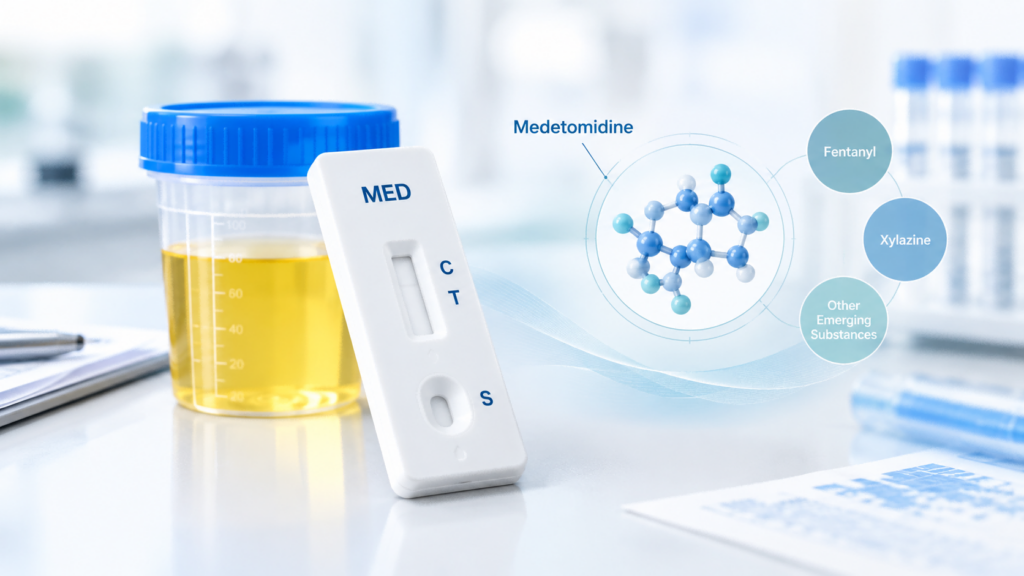
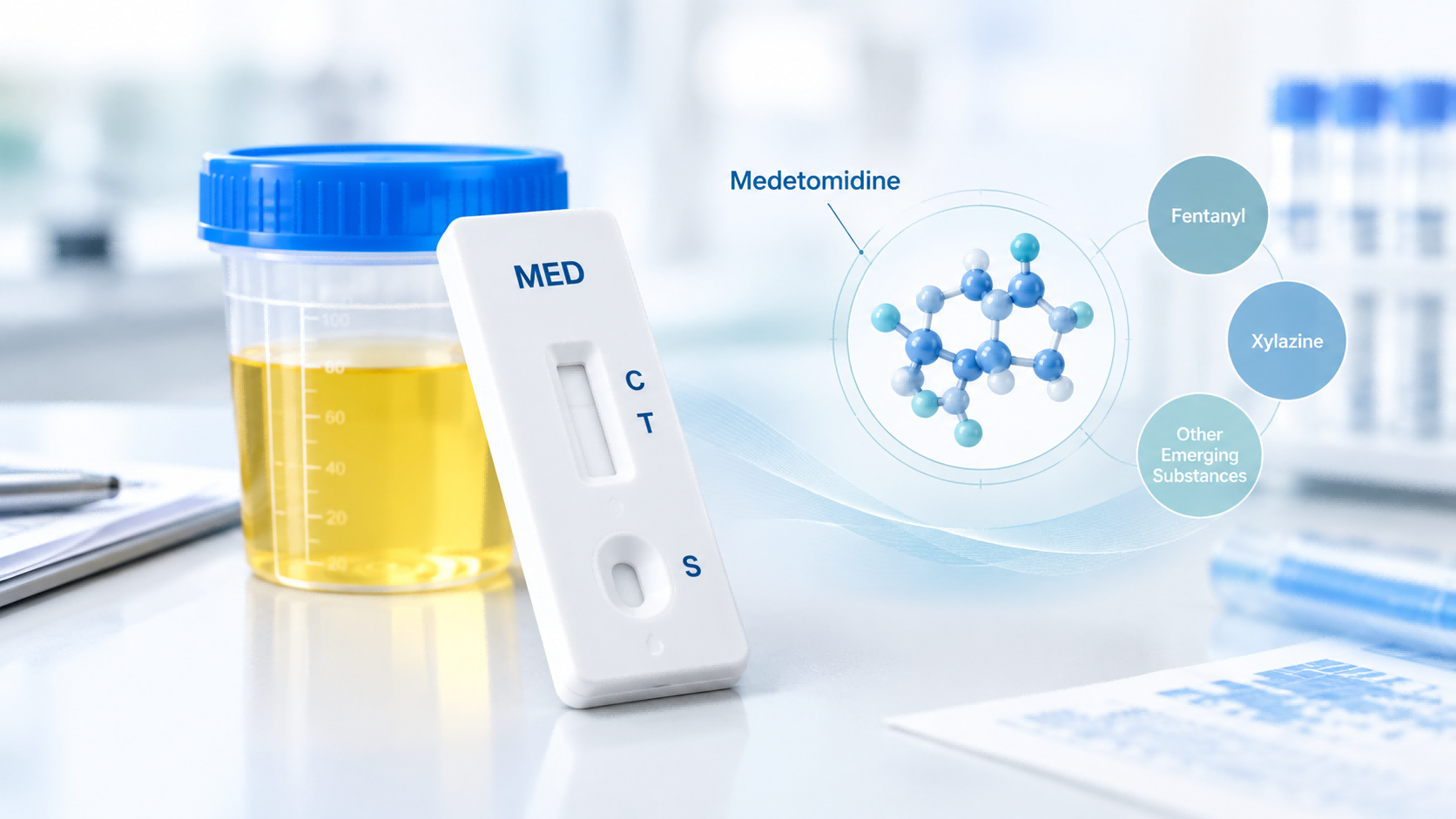
The drug testing market is changing quickly. If you have been following the latest developments in substance abuse testing, you have probably heard more and more about medetomidine (MED).
For a long time, fentanyl and xylazine were the main names people were talking about when it came to emerging substances in the U.S. illicit drug supply. Now, medetomidine is getting much more attention.
So, what is medetomidine, why is it showing up in drug samples, and why are more drug testing companies starting to look at MED testing?
Let’s take a closer look.
What Is Medetomidine?
Medetomidine is a synthetic alpha-2 adrenergic receptor agonist that is primarily associated with veterinary medicine. It is used for sedation and related purposes in animals and is not approved for human use.
The concern today is not simply medetomidine itself. The bigger issue is that it has been found in the illicit drug supply, particularly in samples containing illegally manufactured fentanyl.
According to the U.S. Centers for Disease Control and Prevention (CDC), medetomidine is now present in the U.S. illicit drug supply and is primarily being found together with illicitly manufactured fentanyl.
That has put MED on the radar of toxicology laboratories, public health organizations and drug testing manufacturers.
From Fentanyl to Xylazine – and Now Medetomidine
Drug trends rarely stay the same for very long.
Fentanyl remains one of the biggest concerns in substance abuse testing. In recent years, xylazine also became a major topic because it was frequently found in fentanyl-containing samples.
Now we are seeing another change.
Recent testing data suggest that medetomidine is appearing more frequently, while xylazine detection has declined in some datasets. Labcorp, for example, reported an increase in medetomidine detection among fentanyl-positive urine samples in its 2026 drug trend report.
This does not mean that xylazine has disappeared. It is still an important drug-testing target. But it does show how quickly the illicit drug supply can change.
And this is exactly why emerging drug testing has become such an important topic.
Why Is Medetomidine Showing Up in Drug Samples?
There is still a lot we don’t know about why medetomidine is being added to illicit drugs.
What we do know is that it has been detected together with fentanyl and other substances. In some regions, the number of samples containing medetomidine has increased significantly.
New York is a good example.
New York State reported that medetomidine was detected in 37% of opioid drug-checking samples in 2025, compared with only 4% in May 2024.
That is a big change in a relatively short period of time.
For people working in drug testing, numbers like these are a reminder that today’s testing priorities may not be the same as next year’s.
Why Fentanyl Testing Alone May Not Be Enough
Fentanyl testing has become a standard part of many modern drug screening programs.
But there is a problem: finding fentanyl doesn’t necessarily tell you everything that is in a sample.
Illicit drugs can contain several substances at the same time. A urine sample may test positive for fentanyl while also containing xylazine, medetomidine, benzodiazepines, stimulants or other compounds.
Traditional drug panels were designed around drugs that were already well established. Emerging substances can take time to become part of routine screening.
Medetomidine is a good example.
It is not included in many standard urine drug screening panels, which means a routine drug test may not identify it.
This is one reason we are seeing more interest in targeted tests for emerging substances.
Medetomidine vs. Xylazine
Medetomidine and xylazine are different substances, but there are some similarities.
Both are alpha-2 adrenergic agonists and are associated with veterinary medicine. Both have also been detected in illicit drug supplies, especially alongside fentanyl.
For drug testing professionals, the important point is simple:
A xylazine test is not a medetomidine test.
Testing for one does not automatically mean that you are testing for the other.
As medetomidine becomes more common, laboratories and drug testing providers may need to consider whether their existing panels are still covering the substances that matter in their local market.
Where Could Medetomidine Testing Be Used?
At this stage, MED testing is still an emerging area rather than a replacement for traditional drug screening.
There are several areas where it could become useful.
Clinical and Toxicology Testing
Doctors and toxicology professionals may encounter patients who have been exposed to multiple substances without knowing exactly what was taken.
When an unexpected clinical picture is present, identifying additional substances can provide useful information for toxicology evaluation.
Drug Checking and Harm Reduction
Drug-checking programs are one of the areas where emerging substances are being identified early.
Instead of testing only for the expected drug, these programs can look for unexpected substances that may be present in a sample.
This type of surveillance is particularly useful for identifying changes in the illicit drug supply.
Forensic Toxicology
Medetomidine is also attracting attention in forensic toxicology.
Researchers have reported medetomidine-positive samples in which fentanyl and other substances were also present. This highlights the importance of looking at the overall toxicology picture rather than focusing on a single drug.
Specialized Drug Screening
As awareness increases, medetomidine may also become a target for specialized urine drug screening.
For drug testing manufacturers, this creates an opportunity to develop MED-specific tests and expanded drug panels for markets where medetomidine is becoming a concern.
What About the Future of Medetomidine Testing?
It is still too early to say exactly how big the MED testing market will become.
Drug trends can change quickly, and medetomidine may develop differently in different regions.
However, the current data are strong enough to make it a substance worth watching.
For drug testing companies, this could mean more interest in:
- Medetomidine urine tests
- MED rapid test strips
- Fentanyl + medetomidine panels
- Fentanyl + xylazine + medetomidine panels
- Expanded multi-panel urine drug tests
- Laboratory confirmation testing for emerging substances
The bigger trend is perhaps more important than MED itself.
Drug screening is becoming more dynamic.
Instead of testing the same group of substances year after year, the industry needs to keep an eye on what is actually appearing in the drug supply.
The Bigger Picture: What’s Next for Drug Screening?
Medetomidine is unlikely to be the last new substance to attract attention.
The emergence of nitazenes, new fentanyl analogs and other synthetic compounds shows just how quickly the landscape can change.
For buyers and distributors, this means having access to flexible drug testing products is becoming more valuable.
For laboratories, it means staying up to date with local and national drug trends.
And for manufacturers, it means continuing to invest in R&D so that new testing targets can be developed when the market needs them.