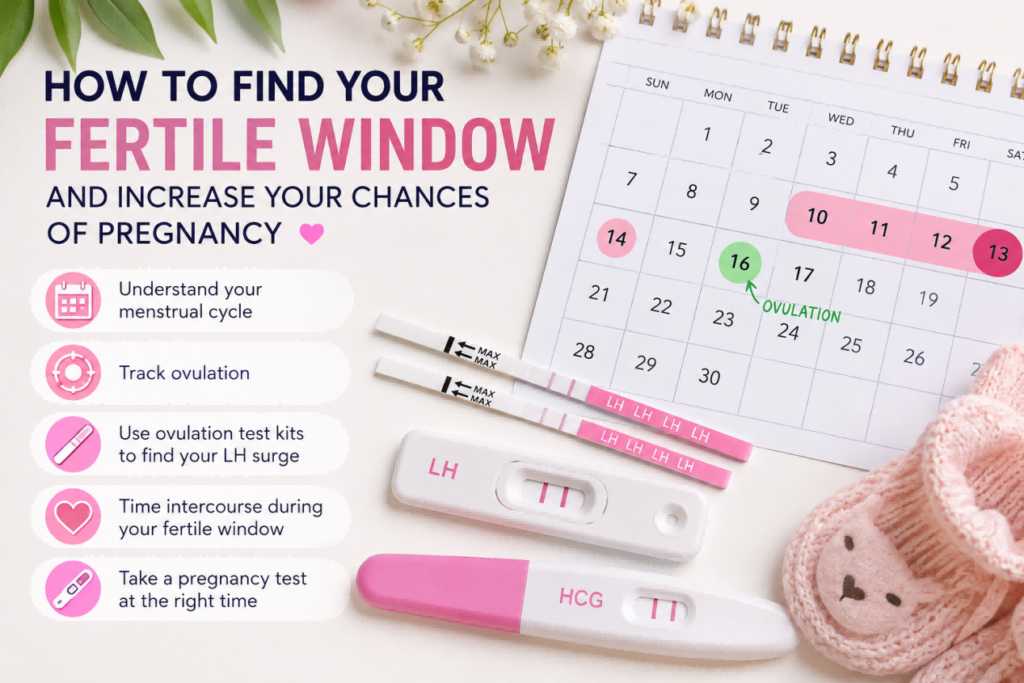
Understanding Your Fertile Window and Why Timing Matters
The fertile window is the short period in each menstrual cycle when pregnancy is most likely to occur. It is centered around ovulation, when an ovary releases an egg.
Because the egg only survives for about 12–24 hours, and sperm can live for up to 3–5 days, pregnancy is only possible within a limited timeframe. This overlap creates the fertile window, usually defined as the five days before ovulation and the day of ovulation.
Many couples miss their most fertile days simply because they are not tracking ovulation. Even with regular intercourse, timing outside this window can significantly reduce the chance of pregnancy in that cycle.
Understanding this concept helps couples shift from guessing to planning, making conception more efficient and predictable.
How Ovulation Determines Your Most Fertile Days
Ovulation is the key event that defines fertility timing. It usually occurs once per menstrual cycle, but the exact day can vary depending on hormone levels, stress, health, and cycle length.
The most important hormonal signal is the luteinizing hormone (LH) surge. This surge happens 24–36 hours before ovulation and triggers the release of the egg.
When LH rises, it signals that the most fertile period has begun. The highest chance of pregnancy is usually on the day of the LH surge and the following 1–2 days.
Because ovulation timing can vary, relying only on calendar tracking is often inaccurate. This is why many couples use ovulation test kits to identify their fertile window more precisely.
How to Detect Ovulation Accurately Using LH Test Kits
LH ovulation test kits are one of the most reliable and convenient ways to detect the fertile window at home.
These tests measure luteinizing hormone levels in urine. When the test shows a positive result, it means ovulation is likely to occur within the next 24–36 hours.
To use ovulation tests effectively, testing should start a few days before expected ovulation based on cycle length. For irregular cycles, testing may need to continue for a longer period each month.
When a positive result appears, intercourse should be timed on that day and the following day to maximize the chance of conception.
In addition to test results, the body also provides natural fertility signs. Cervical mucus often becomes clear, slippery, and stretchy like egg white during ovulation. Some women may also experience mild pelvic discomfort or increased libido.
However, these signs can vary between cycles, so combining natural observation with LH ovulation tests provides the most accurate fertility tracking method.
By consistently using ovulation tests and understanding the fertile window, couples can significantly improve their chances of achieving pregnancy naturally and reduce the time needed to conceive.